Homage to Catalonia
A biased approach to the Catalan independence referendum
Referendum voters show their ballots before the riot police (Emilio Morenatti / AP)
In 1938, just a year and a few months after joining the Republican side in the Spanish Civil War, George Orwell published his experiences as a combatant in a book he titled "Homage to Catalonia". The title might appear as an odd choice, as during his time in Spain he was labeled traitor by those whom he thought were his peers, he witnessed the disarray and chaos in which the Spanish Republican Government was immersed, and he experienced slaughter, fear, and injury. And yet, he branded and defined his book as an homage, writing at the end of it:
Curiously enough the whole experience has left me with not less but more belief in the decency of human beings.
Amidst the current convoluted times, often made so by renewed and reinvigorated partisan political ideologies, Orwell's considerations may also encounter a newfound relevancy almost 80 years since the original publication of his book. Consequently, it might be beneficial to once again scrutinize which values we keep at the core of our contemporary societies, so that we can decide whether those are worth treasuring, upholding, and maybe even paying homage to.
* * *
On October 1st, 2017, the regional Catalan Government held a referendum for independence which had previously been deemed illegal by the Spanish Constitutional Court. The referendum was nonetheless held (albeit without meeting the international requirements established for such a vote), and more than 2 million people were able to cast their ballots to decide whether they wanted to become part of a new independent state or not. Taking into account that Catalunya’s population index is approximately 7.5 million, it might seem that 2 million ballots represent a low participation rate, but the circumstances in which the vote was held had a direct impact not only on the number of votes casted but also on what the outcome of the vote would be.
At 10 a.m. that day, I began walking down the road towards a small neighbouring district school which had been assigned as my respective polling station. Days before, I had been struggling to find official information describing where I was supposed to cast my ballot (and whether I would be able to do so), since the Spanish Guardia Civil had shot down the official website which held the electoral census database. Previously, it had been possible to access the website through a proxy hosted outside of Spain, but not long after it became online, ref1oct.cat was already inaccessible. This small victory for the Spanish Government would be short lived though, as different replicas of the site and database began to be uploaded under various domain names at a faster pace than they could be intercepted, one of them being particularly hilarious: guardiacivil.sexy. Whilst this digital brawl took place the Android app held its ground, and due to it, me and many others were able to learn where the polling stations were going to be located. I got appointed to the nearby "Ramon Llull" school, but when I got there the ballot boxes had already been seized by the police and a large crowd was running away from their rubber bullets shots, the same ones which had been banned in Catalunya since 2014 due to several injuries and a woman losing an eye[1].
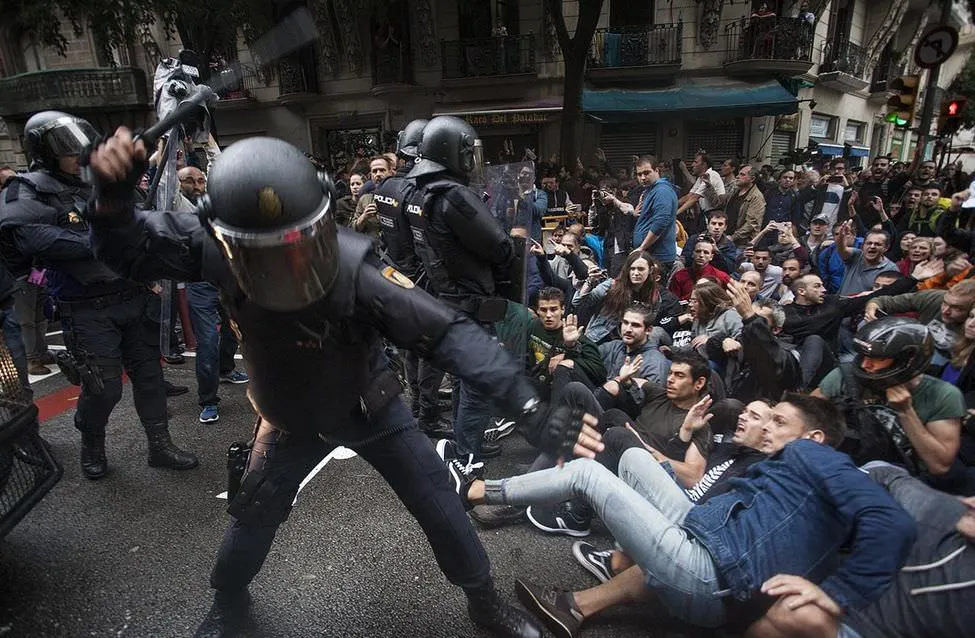
Police charging on Sardenya with Diputació streets after the eviction of the Ramón Llull school (Robert Bonet / Wikipedia)
A week before the vote, the Spanish Government had overrode the fiscal autonomy of Catalunya[2] and deployed state security forces numbering 12.000 policemen from across the country to Catalan territory[3]. Some of them had been given triumphant farewells from their communities whilst crying “A por ellos”[4], which could be translated and interpreted as a violent war cry meaning “go get them”. To understand the importance that deployment had for Catalan society, it’s essential to know that Catalunya already has its own police force named “Mossos d’Esquadra”, which is commanded by the local government and shares competencies with two other central state enforcers: “Guardia Civil” and “Policía Nacional”. By allocating extra non-local security forces to Catalunya, the Spanish Government was indirectly sending a message, they didn’t trust the local police force to prevent the referendum from happening as they had been ordered to do so by the Spanish constitutional court.
It’s clear that the Catalan Government had been following a political roadmap towards independence since September 2015, when a coalition of parties in favor of secession consolidated a majority of seats in the regional parliament. Since then, tension between Catalan and Spanish governments rose to the point of non-communication. Despite their roadmap, the Catalan Government had always known (and were told many times so), that their Spanish counterpart wouldn’t allow any form of independence referendum. They knew that even if they tried to organise an unilateral vote it would immediately be deemed illegal by any court the Spanish Government appealed to, and they knew they had to reach an agreement with Madrid to make that referendum possible. Basically, the Catalan government was very much aware an independence referendum wasn’t going to happen in any legal and juridically binding manner; therefore, they either had to find another way, or desist from their political promises and aspirations which had consolidated their power. The arguments from Madrid were clear, Spain is indivisible and the Spanish constitution doesn’t permit any independence vote to be held. If Catalan officials wanted to change the constitution—the central government proposed—, they only needed a state-wide overwhelming victory which would allow them to do so. And that, of course, wasn’t going to happen either.
The political conundrum emerges from a clash between legality and the democratic principle, and which one is more legitimate and should prevail over the other in a modern democratic state. Is it more democratic to follow the rule established by a constitution approved by an elected parlament, or is the direct vote (even if outlawed) a better expression of democracy? Even then, how are we to articulate a regional will for secession which could impact the state as a whole? It’s tough to say, especially when there’s no possibility for debate. Ever since 2015 and even a few years before then, there had been a relentless political back and forth between the pro-independence regional Catalan parties and the state-wide ones through mainstream media. The slogans were repetitive and dialogue was obscured by rotund statements and immovable opinions. Their intent was obvious, there was no need for a reasonable conversation when both sides could benefit politically from sowing dissension amongst society. On September 2017 things got serious though, when the Catalan parlament passed a law[5] in a questionably legal manner, which allowed the chamber to declare independence unilaterally if the outcome of a given future referendum was in favour of it.
When the shots began on October 1st, I was one of the many who were being shot at. Young and old alike had been standing hands up, peacefully occupying the street in front of the polling station, to prevent the police from bursting in. Their efforts were to no avail as the security forces violently pushed through the crowd and seized the ballot boxes whilst at the same time managing to damage the school premises. I got there late, the police were quickly making their way back to their trucks but the crowd was protesting by sitting down in front of their vehicles trying to obstruct their way out. There had been no need for the previous violence, but the following rubber bullet shots against peaceful citizens were impossible to justify. A young man lost an eye and many others where injured.
Spain’s democracy hadn’t lived such an ill-fated day since its reestablishment on 1978. State police attacked and injured fellow citizens of all ages who were protesting non-violently, sexually harassed women, and destroyed educational institutions. All that, just for the sake of fighting an idea. Schools were torn apart but so were we after what we had witnessed. Devastated, we even had to listen how the Spanish Government declared the police charges as “proportional”[6], how other political representatives declared the popular strike that followed as “nazi”[7] and how the non-elected king of Spain took sides and blamed Catalan democractically-elected officials for the turmoil without condemning police violence[8].
In Catalunya there are lots of people from all walks of life and with different political opinions who have peacefully expressed their will to vote calling upon democracy and common sense to be able to decide their future in peace. This is an issue about the extent of our democratic institutions and it’s worth debating about. What the current Spanish Government doesn’t understand is that they can’t hold hostage a region of 7.5 million people in the name of the law and a constitution most of them didn’t vote for; they don’t understand that time doesn’t heal all wounds, nor do they understand it’s not possible to claim victory over an idea through violence. That’s exactly what a democracy shouldn’t be about. It might be true that the majority of those 7.5 million people don’t want independence, but the only way of knowing whether that’s a fact or not is by asking them and by opening a social and political debate around those issues, not by denying the existence of 2 million people or blaming their ideals to a non-existent dogmatic education. That’s ignorance and propaganda. There’s a part of Catalunya who wants to become a new progressive republic, with new laws and new ideals, and holding it back with violence and fear won’t do nothing more than kindle a state-wide flame of nationalism and oversimplified thoughts; on the other hand, discussing the implications of such independence could allow everyone to make a better informed decision about their futures. We should aim to uncover the complexities of a political debate instead of mudding the waters of mutual understanding by choosing political profit over social wellbeing.
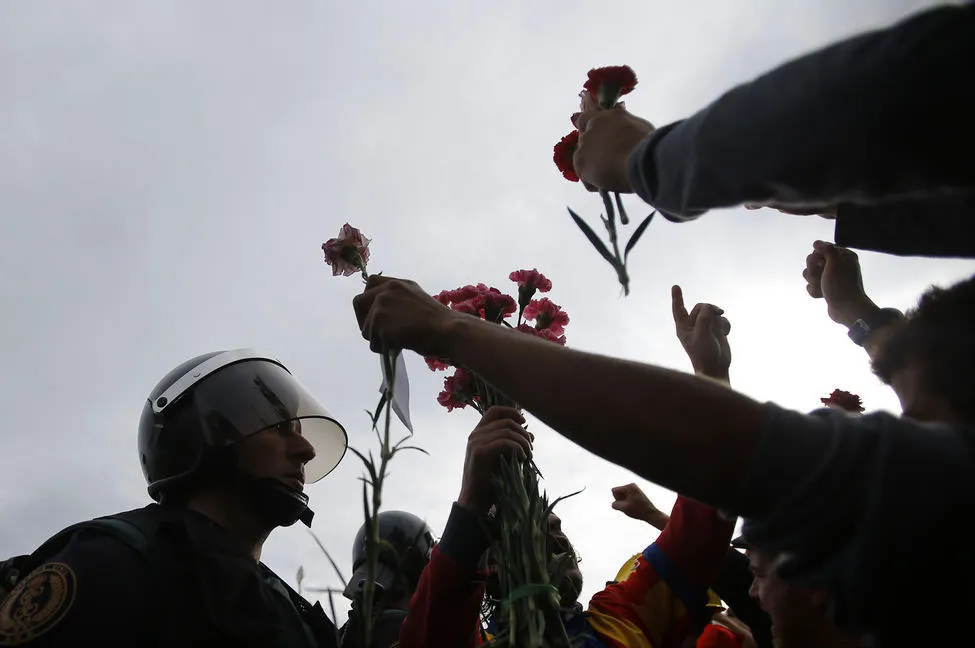
Several people show carnations to the policemen who surround the voting center of Sant Juliá de Ramis (Francisco Seco / AP Photo)
On the following days after October 1st 2017, the call for Catalan independence turned from a hazy nationalistic ideal with unknown real world consequences, to a revolutionary popular call for freedom, democracy, civil rights and emancipation. These should be ideals each and everyone of us stands for, but as long as there’re people who don’t understand that and can justify violence against fellow citizens, the divide in Spanish society will do nothing else but grow.
There’s a lot to be said about the success and organisation of the referendum despite police violence, an antagonistic central government, previous intervention of regional institutions[9], raids and undercover operations[10] [11], lack of funds, and lack of official governmental support. The popular defence of the right for everyone to vote and the pacific nature of the protests in Catalonia have shown us how the decency Orwell spoke about 80 years ago can still be found in our contemporary society. Even when power struggles keep mudding the purest ideals, even when we are made to believe that confrontation is the only choice, and even in the face of violence, the majority of catalan society hasn’t relented in their peaceful approach towards their goal of achieving an inclusive democracy in which people are asked about their opinions, instead of being beaten for having them.
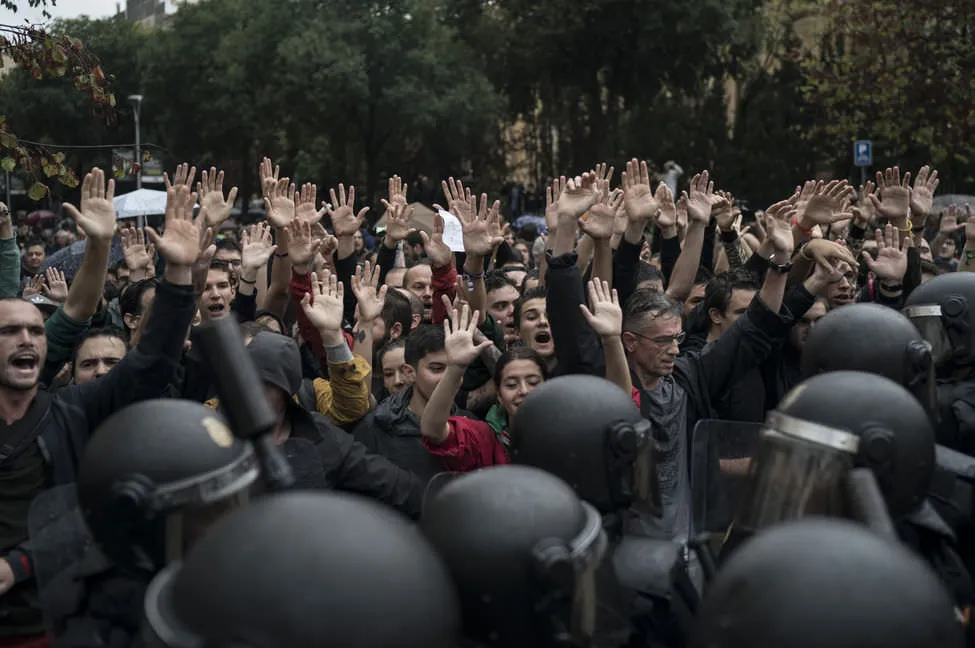
People with raised hands, before riot officers in front of a school in Barcelona (Felipe Dana / AP Photo)
Information sources:
Las pelotas de goma, prohibidas desde este miércoles en Catalunya: https://www.lavanguardia.com/vida/20140430/54407400420/pelotas-de-goma-prohibidas-catalunya.html ↩︎
El Gobierno interviene todos los pagos de servicios esenciales y nóminas de la Generalitat: https://politica.elpais.com/politica/2017/09/15/actualidad/1505470229_074445.html ↩︎
El despliegue de la Policía Nacional y la Guardia Civil se mantendrá en Cataluña: https://www.20minutos.es/noticia/3150124/0/depliegue-policia-nacional-guardia-civil-cataluna-mantendra/
Interior informa al Govern de que manda más efectivos a Catalunya para “mantener el orden”: http://www.elperiodico.com/es/politica/20170922/interior-manda-mas-efectivos-a-catalunya-para-mantener-el-orden-6303371 ↩︎Interior desautoriza el acto de despedida de la comisaría de Córdoba a los policías desplazados a Cataluña: https://politica.elpais.com/politica/2017/09/26/actualidad/1506424559_624088.html
Vítores a policías que van a Catalunya con gritos de “a por ellos”: http://www.elperiodico.com/es/politica/20170925/despiden-policia-nacional-van-catalunya-gritos-de-a-por-ellos-6310462 ↩︎El Parlament aprueba la ley de referéndum tras abandonar el pleno la oposición: https://www.publico.es/politica/catalunya-parlament-aprueba-ley-referendum-abandonar-pleno-oposicion.html ↩︎
Santamaría sostiene que “no ha habido referéndum” y culpa a Puigdemont de los incidentes: https://www.infolibre.es/noticias/politica/2017/10/01/reaccion_santamaria_gobierno_70168_1012.html ↩︎
Minuto a minuto. La crisis de Catalunya: http://www.eldiario.es/catalunya/politica/MINUTO-Diada_13_685361458_13081.html ↩︎
Duro mensaje del rey contra la Generalitat: “Se ha situado al margen de la democracia”: https://www.eldiario.es/politica/rey-felipevi-mensaje-catalunya-1-0_0_693281643.html
El Govern responde con el silencio al mensaje del Rey: https://www.lavanguardia.com/politica/20171004/431779540673/ausencia-reacciones-independentismo-discurso-rey-felipe-vi-catalunya.html
Por qué el discurso del rey Felipe VI sobre el referéndum por la independencia de Cataluña muestra la gravedad de la crisis que vive España: https://www.bbc.com/mundo/noticias-internacional-41500414 ↩︎“1-O” Documentary – English Version: https://www.youtube.com/watch?v=MmszwyfInNY ↩︎
La Guardia Civil tiene infiltrados en imprentas y empresas de mensajería de Cataluña: https://www.elconfidencialdigital.com/articulo/seguridad/Guardia-Civil-infiltrados-mensajeria-Cataluna/20170919191125086765.html ↩︎
La Guardia Civil continúa inspeccionando imprentas y redacciones de diarios catalanes: https://www.publico.es/politica/referendum-1-guardia-civil-inspecciona-furgonetas-alrededores-imprentas-referemdum-1.html ↩︎